Living Down Under - Outback & Co
Page 2 / 11
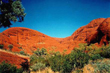
Thus I would rather like to provide some information about the people who live and work "in the middle of nowhere", than to tell some romantic stories about travelling the outback. There is not a lot of those people - Alice Springs, the biggest town in the middle of the continent has only got 26,000 inhabitants - but they are the ones who consider themselves the "real" Australians.
Most of the people in the remote areas earn a living as farmers. They breed cattle in the northern part of the outback and sheep in the southern areas, because sheep and kangaroos are the only ones to cope with the dry "spinifex" grass in "the big scrub". Due to the rather unpleasant living-conditions, farms are much bigger than in Germany. Their average size can be compared to the area of Hamburg, Berlin and the Saarland - all put together. The biggest farm is as large as Belgium (30,000 km2, 150,000 cows, 5 inhabitants).
So the only kind of borders you will find in central Australia are fences to keep the cattle on their right terrain. The world´s longest wire netting runs right through the heart of Australia: on a distance of 5,320 kilometers the socalled "Dogfence" was erected to protect the sheep from dingoes. In order to find and round up their animals, the modern Australian "cowboys" have to use motorcycles, "bull buggys" (Jeeps) and even helicopters.


Last update: 26/03/02.